When 700 Applicants Hit One Job Post: The Hidden Cost of Recruiter Fatigue
TL;DR
High applicant volume happens more than you think and it is overwhelming recruiters in 2026. Recruiter fatigue is a real problem. We break down how communication, scheduling, and fragmented tools are driving recruiter fatigue, and how centralized texting workflows and early-stage filtering can fix it.
Key Stats at a Glance
- Recruiters spend up to 30–40% of their time on administrative tasks, including scheduling and coordination.
Source: Society for Human Resource Management
- The average time-to-hire is ~36–42 days, often extended by delays in communication and scheduling.
Source: Bureau of Labor Statistics - 60%+ of candidates report dropping out of a hiring process due to poor communication or delays.
Source: CareerBuilder - SMS messages have open rates as high as 98%, with significantly faster response times than email.
Source: Gartner
The Problem Starts Here
Let’s start with a number that should make any recruiter pause:
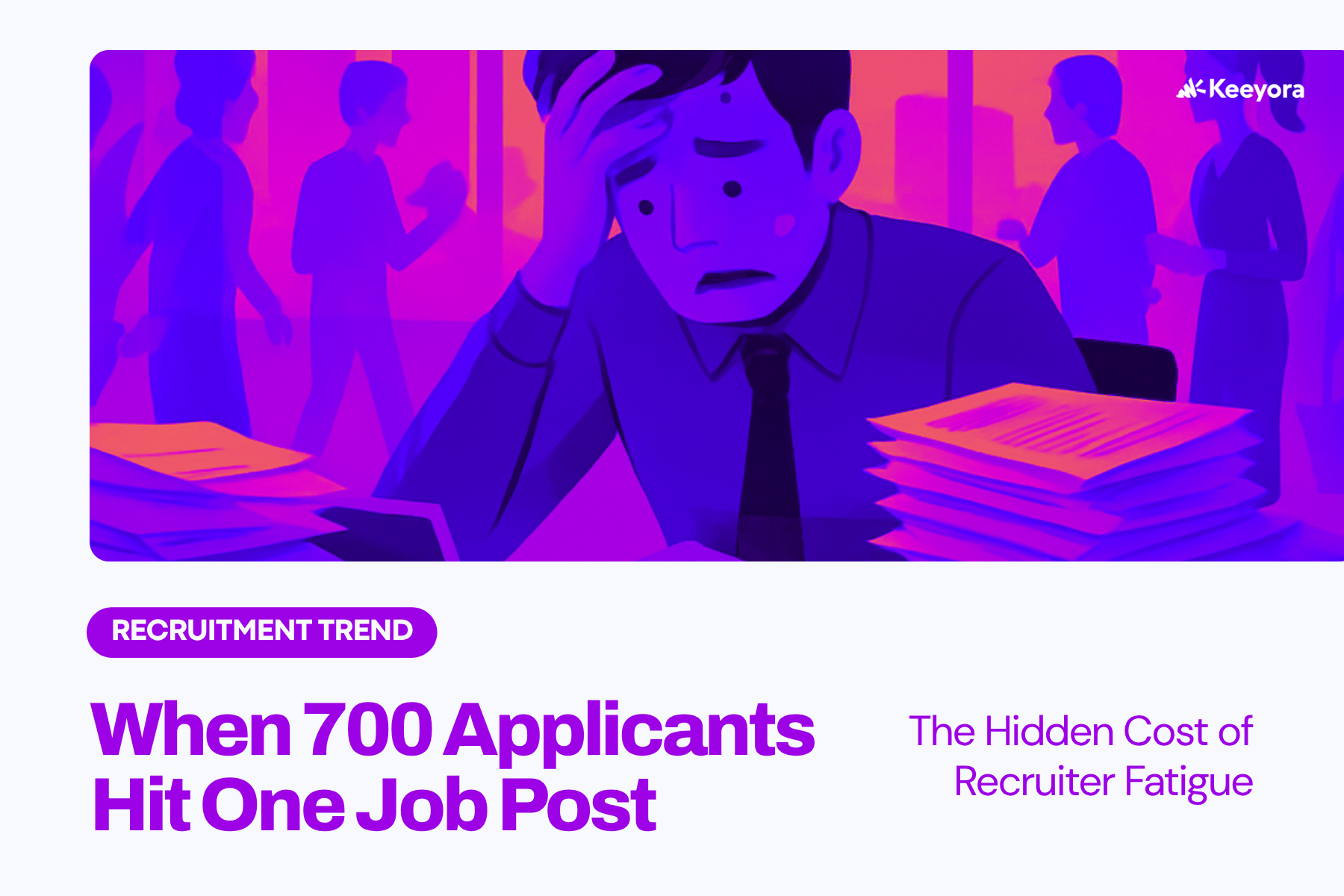
Hundreds of applications per job. Sometimes 700+. Sometimes more. That’s not a pipeline. That’s a flood.
On the surface, it sounds like a good problem to have. More applicants should mean better talent and stronger hiring outcomes. But the reality is more complicated. Volume at this scale doesn’t just increase opportunity—it increases operational strain.
Because before interviews are booked, before shortlists are built, and before hiring managers are looped in, recruiters are already deep in the work of sorting, reviewing, and initiating conversations.
And that’s where fatigue begins—not at the end of the funnel, but right at the start.
The Real Bottleneck Isn’t Hiring. It’s Handling Volume.
Most hiring conversations still focus on sourcing strategies. How do we attract more candidates? How do we expand reach?
In 2026, that’s no longer the limiting factor.
The real challenge starts after candidates apply. Recruiters are now expected to process large volumes of inbound applications while still moving quickly enough to engage top talent before competitors do.
In practice, it looks more like:
- Reviewing and triaging hundreds of applications
- Identifying qualified candidates quickly
- Initiating outreach across multiple roles
- Moving candidates into screening and scheduling
Individually, these are standard responsibilities. At scale, they become a throughput problem. The system itself starts to slow down under the weight of volume.
Where Things Break: Communication and Scheduling
And just when it feels like you’ve made progress narrowing things down, the real work begins: actually coordinating with all of these candidates.
At lower volumes, this is manageable. At scale, it quietly turns into one of the most time-consuming parts of the job. In fact, recruiters can spend up to 30–40% of their time on administrative tasks like scheduling and coordination.
A typical scheduling workflow includes:
- Back-and-forth availability coordination
- Adjustments and rescheduling
- Managing time zones across candidates and interviewers
- Tracking no-shows and follow-ups
These tasks are simple in isolation but repetitive and time-consuming in aggregate. As volume increases, these delays don’t just create internal friction—they extend hiring timelines. The average time-to-hire now sits around 36 to 42 days, and communication bottlenecks are a major contributor.
The Hidden Drain: Context Switching Across Tools
The challenge isn’t just the number of conversations–it’s where those conversations are happening.
Most recruiting teams still rely on a mix of:
- Email for outreach and coordination
- LinkedIn for sourcing and initial contact
- ATS platforms for tracking and documentation
- Calendar systems for interview scheduling
Because communication is fragmented across these systems, recruiters are forced to constantly switch contexts.Instead of progressing conversations, they spend time reconstructing them—locating messages, reviewing past interactions, and figuring out next steps.
Over time, that constant switching starts to wear on you and becomes a real driver of recruiter fatigue.
The Operational Risk: Handoffs and Time Off
This issue becomes more visible during team transitions.
When a recruiter steps away, another team member often needs to take over active roles. Without a centralized communication system, that handoff is rarely seamless.
What usually follows is a mix of:
- Incomplete or scattered conversation histories
- Missing context on candidate status
- Unclear ownership of next steps
These gaps don’t just slow things down—they impact candidate experience directly. More than 60% of candidates say they’ve dropped out of a hiring process due to poor communication or delays.
The Shift: Why Centralized Communication Matters
So the question becomes: how do you actually make this manageable at scale?
The answer, for more teams lately, has been surprisingly simple: centralize and bring everything into one place. For example:
- Consolidating candidate interactions into a single thread
- Making scheduling progress transparent
- Enabling seamless team collaboration and handoffs
- Reducing the mental effort required to stay organized
This shift doesn’t just improve efficiency, it stabilizes the entire hiring process.
When recruiters no longer need to manage multiple systems just to stay on top of conversations, they can refocus on evaluating and engaging candidates.
Why Texting Is Emerging as the Core Channel
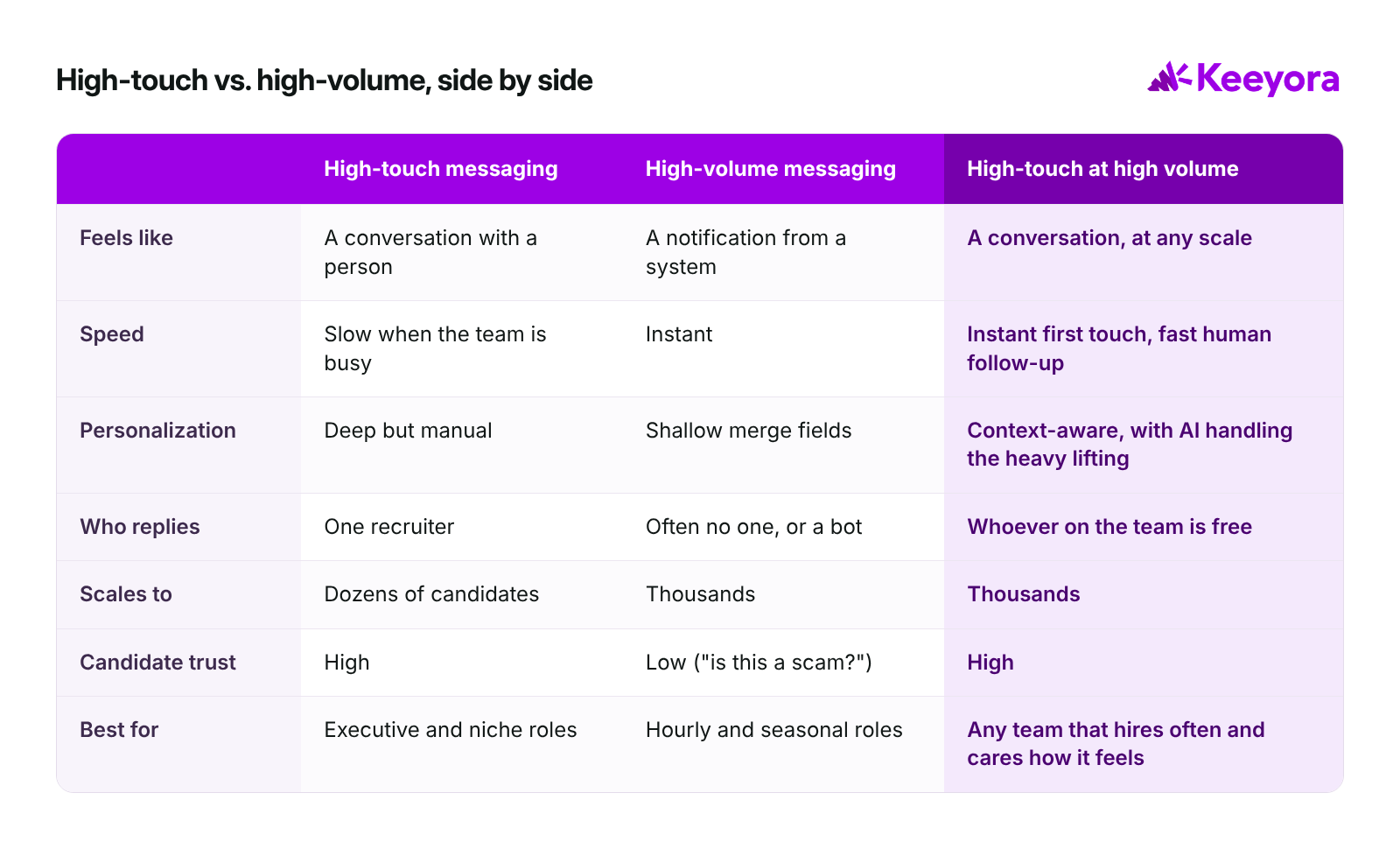
This is also why texting has been gaining so much traction in recruiting workflows. It’s becoming a central communication channel—not just because it’s fast, but because it reduces friction.
Compared to traditional channels, texting provides clear advantages. SMS messages have open rates as high as 98%, with significantly faster response times than email.
- A single, continuous thread per candidate
- Faster response times and higher engagement rates
- Less formality and fewer barriers to reply
And when texting is actually built into your hiring workflow, it starts to unlock a few important advantages:
- Centralized, team-wide visibility into conversations
- Streamlined scheduling coordination
- Reduced risk of missed or delayed communication
The result is a more efficient and responsive process, particularly in high-volume hiring scenarios.
Reducing Volume at the Source
While improving communication and scheduling is critical, there is also an opportunity to reduce workload earlier in the funnel.
Not all applicants require the same level of engagement, but identifying which candidates to prioritize can be time-consuming.
Naturally, teams start asking a different question at this stage: what if fewer of these candidates needed to make it this far in the first place?
When you introduce an earlier layer of filtering—something that surfaces stronger candidates while flagging potential risks—you start to change the shape of the entire funnel:
- Reducing time spent on unnecessary outreach
- Limiting avoidable scheduling and screening
- Improving overall pipeline efficiency
Instead of constantly reacting to volume, teams can finally get back to controlling it.
The Bottom Line
Recruiter fatigue in 2026 is less about effort and more about system design.
When communication is fragmented and scheduling is manual, high applicant volume becomes difficult to manage. The result is slower hiring processes, inconsistent candidate experiences, and increased burnout across teams.
Addressing this requires a shift in how recruiting workflows are structured.
High-performing teams are:
- Centralizing candidate communication
- Simplifying scheduling processes
- Increasing visibility across stakeholders
- Reducing unnecessary steps early in the funnel
In an environment where hundreds of candidates can enter the pipeline at once, efficiency is no longer optional. It is foundational to everything that follows.