High-Touch Hiring at High Volume: Why You No Longer Have to Choose
For years, talent teams have been told to pick one: a personal candidate experience, or the ability to hire at scale. You can't have both.
That trade-off made sense when every personal touch meant a recruiter typing every message by hand. It doesn't anymore. The teams winning today's hiring market are the ones delivering a high-touch experience inside a high-volume operation.
This post breaks down what each approach really means, why they've been treated as opposites, and the principles that let you run both at once.
What is high-touch candidate messaging?
High-touch messaging is communication that feels like it came from a real person who knows who the candidate is. It's timely, specific, and two-way.
In practice, it looks like this:
- Personal context. The message references the role, location, shift, or conversation the candidate actually had.
- Real replies. When a candidate asks a question, a human (or something that sounds like one) answers it quickly.
- Continuity. The candidate isn't starting over every time a different coordinator picks up the thread.
- The right channel. Candidates are reached where they already are, usually their phone, not buried in an inbox.
High-touch hiring is why candidates accept offers, show up on day one, and refer their friends. Its weakness has always been the same: it doesn't scale when one person does it by hand.
What is high-volume candidate messaging?
High-volume messaging is built to move hundreds or thousands of candidates through a pipeline quickly. Think warehouse, retail, hospitality, healthcare, seasonal, and campus hiring.
Its strengths are real:
- Speed. Automated outreach goes out the moment someone applies.
- Consistency. Every candidate gets the same reminders, screening questions, and next steps.
- Efficiency. Small teams can manage pipelines far bigger than they could by hand.
The cost is usually the candidate experience. Messages start to feel robotic: generic templates, no-reply numbers, chatbots that can't answer a simple question. Candidates disengage, ghost, or assume the text is a scam. The volume is there, but the connection isn't.
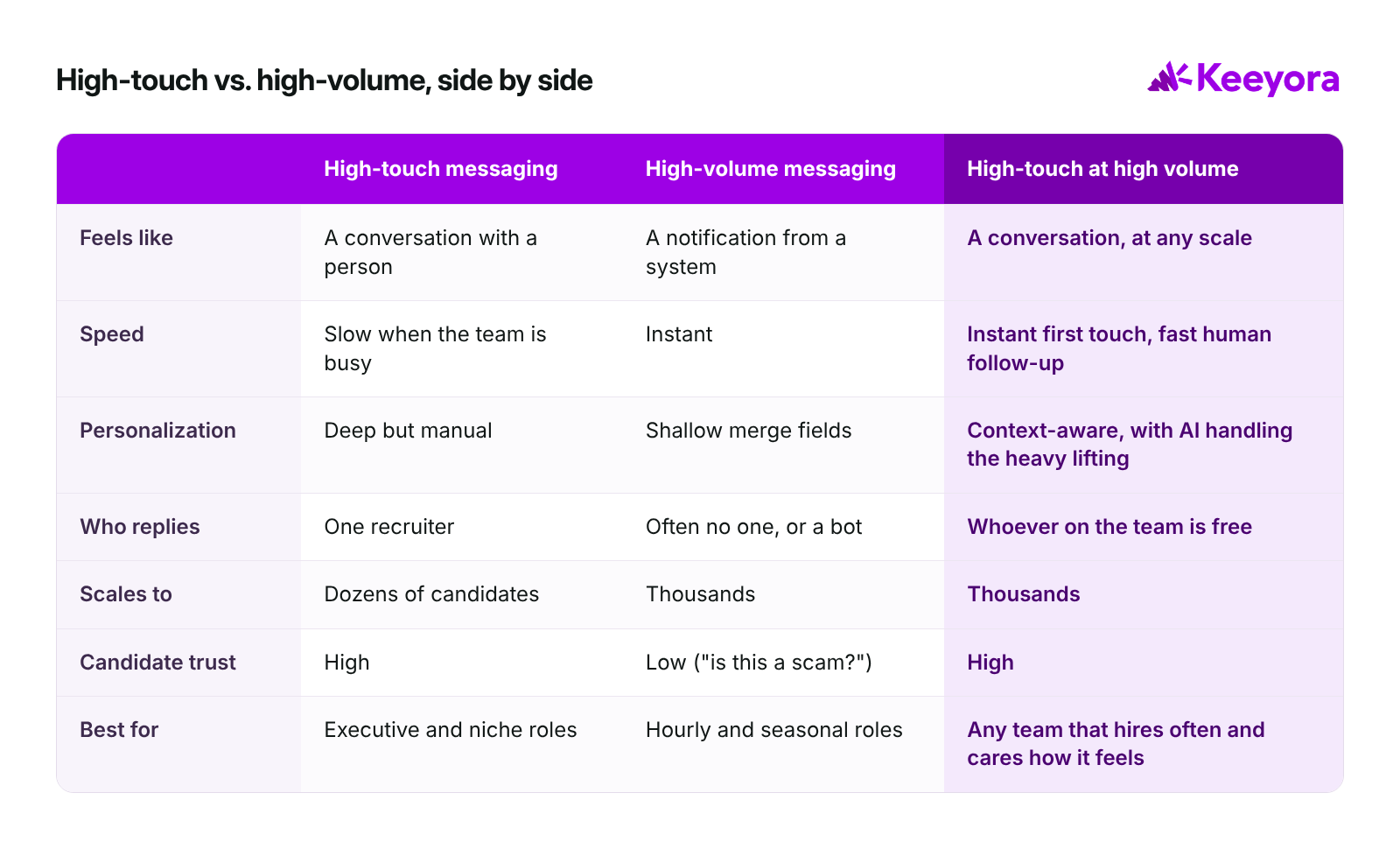
High-touch vs. high-volume, side by side
Why the trade-off existed, and why it's breaking down
The trade-off came from tooling, not from candidates. Candidates never wanted robotic hiring; teams just didn't have a way to be personal at scale.
Three things kept the two worlds apart:
- One inbox per recruiter. Conversations lived on individual phones and accounts. If a coordinator was off shift, the candidate waited.
- Automation without judgment. Early automations could send messages but couldn't tell when a human needed to step in.
- Untrusted channels. Texts from random numbers look suspicious, so even well-written messages got ignored.
Each of those is now solvable. Shared team inboxes keep conversations moving no matter who's working. AI can draft personal replies and flag the moments that need a human. And branded, verified messaging channels are making texts from employers look as trustworthy as texts from your bank.
Five principles of high-touch hiring at high volume
- Automate the predictable, humanize the important. Let automations handle confirmations, reminders, and status updates. Save human attention for questions, objections, and offers.
- Make the inbox a team sport. When coordinators share an inbox and a number, any teammate can jump into a conversation. Candidates get answers in minutes, not after someone's next shift.
- Keep boundaries where they matter. Shared doesn't mean everyone sees everything. Your corporate recruiting team and your warehouse team can each share their own number and messages without seeing each other's.
- Use AI to sound more like you, not less. The goal of AI isn't to replace the recruiter's voice. It's to draft faster, summarize threads, and keep every reply personal even on your busiest day.
- Earn trust in the first message. A recognizable sender, a clear reason for reaching out, and a real way to reply. If a candidate wonders whether your text is a scam, you've already lost time.
It's not just recruiting anymore
The candidate experience doesn't end at the offer letter. The same person who applied becomes a new hire in onboarding, then an employee HR needs to reach.
That's why high-touch messaging now belongs to the whole talent team, not just recruiters:
- Recruiting keeps applicants engaged from apply to offer.
- Onboarding confirms paperwork, start dates, and first-day details so new hires actually show up.
- HR reaches employees quickly on the channel they actually read.
When every stage of the lifecycle speaks with the same personal voice, people feel that consistency, from the first text to the last.
How Keeyora does both
Keeyora sits right at the intersection of high-touch and high-volume. Simple candidate messaging, AI, and automations help talent teams move faster without losing the personal touch.
Here's what that looks like in the product:
- AI and automations. Handle the repetitive outreach automatically, and keep every human reply personal.
- Integrations with the systems you already use, so messaging lives inside your existing hiring and HR workflow.
You shouldn't have to choose between hiring fast and hiring well. With Keeyora, you get high-touch hiring at high volume. Book a demo to see it in action.