5 Predictions for Talent Teams in 2027
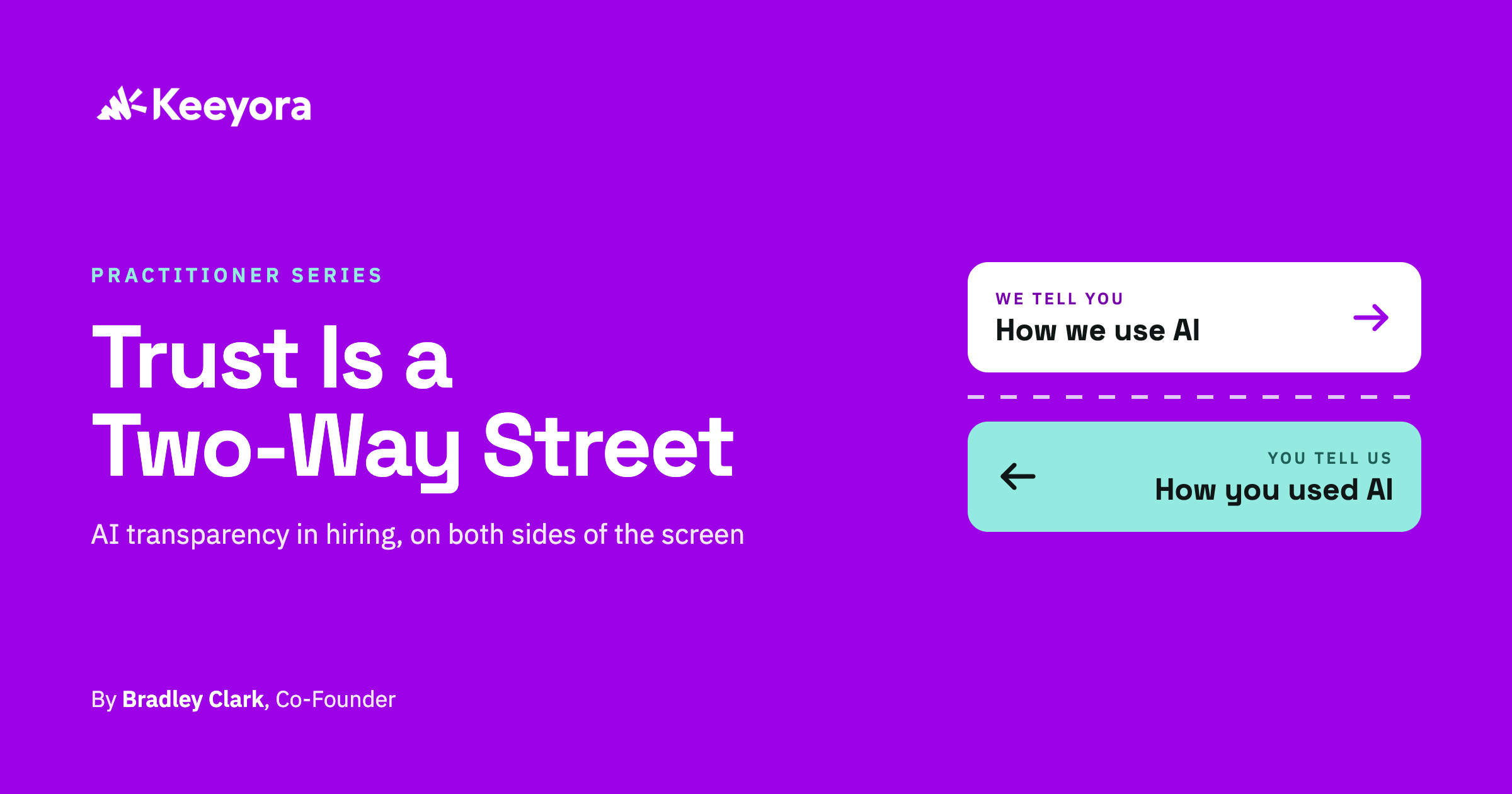
AI is now on both sides of the hiring screen. Talent teams use it to write postings, sort applications and draft messages. Candidates use it to research, apply, prep and, sometimes, to cheat.
The result is a trust gap that runs both ways. Only 26% of candidates trust AI to evaluate them fairly. Meanwhile, Gartner predicts that by 2028, 1 in 4 candidate profiles worldwide will be fake.
As our co-founder Bradley Clark puts it, AI isn't going anywhere, but it is reducing trust on both sides of hiring. So every prediction below comes back to one question: how do talent teams earn trust when everyone is using AI?
1. AI disclosure goes two-way
Most companies that talk about AI in hiring only cover half of it: how they use it. In 2027, the best talent teams will also spell out how candidates may use it, drawn at the same line.
Bradley's rule of thumb is simple: AI may amplify the real you, but it may not replace, fabricate, or impersonate you. Polishing your writing, organizing your resume and practicing answers are welcome. Inventing experience or reading AI answers live in an interview is not.
The symmetry is what makes it feel fair. And clear rules help honest candidates more than dishonest ones, because vague rules get gamed and clear ones get followed.
What to do: publish one short policy that answers both "How do you use AI?" and "How may I use AI?" with equal clarity.
2. "Humans decide" gets said out loud
What most candidates fear isn't AI itself. It's that a machine rejected them and no person ever looked. Saying "we use AI" doesn't calm that fear. Saying exactly where AI stops and a person starts does.
In 2027, expect talent teams to repeat that line at every touchpoint where the fear spikes: the posting, the confirmation, the interview invite and, above all, the rejection. A rejection message is where most companies say the least, and where it matters most.
One caution from Bradley: keep the promise honest. If AI filters applications before a recruiter sees them, "a human reviews every application" isn't true. Claim only the decision a human actually owns, and be ready to explain how you audit your tools.
What to do: add one line to your rejection message, such as "Decisions about who advances are made by humans, not AI."
3. Agents take on the logistics
The next step past simple automations is agentic workflows: AI that can carry a task across several steps on its own. In hiring, the obvious first jobs are the repetitive ones. Think scheduling interviews, sending reminders, confirming start dates and chasing missing paperwork.
That's good news for high-touch hiring. Every hour an agent saves on logistics is an hour a coordinator can spend on the conversations candidates remember. The risk is the opposite: letting agents creep into the moments that need judgment and a human voice.
Bradley also flags a wilder possibility: agent-to-agent hiring, where a candidate's AI talks to an employer's AI. Whether or not that arrives in 2027, the same rule applies. Agents handle the process; people make the decisions.
What to do: list your candidate touchpoints and mark each one as "agent can handle" or "a person should own this."
4. Verified messages become a trust signal
Candidates have good reason to be wary of a text from an unknown number. The FTC reports that job scam losses tripled between 2020 and 2023, then topped $220 million in just the first half of 2024. On the employer side, fake candidates are rising too.
That makes the sender itself part of the message. A text from a random number reads like spam, however well it's written. A message that clearly comes from your company, with your name and branding, earns a reply.
In 2027, expect branded, verified channels like RCS business messaging and WhatsApp to move into hiring. It's a direction we're actively building toward at Keeyora, starting with shared team numbers.
What to do: make sure candidates always know who is texting them, and avoid personal or rotating numbers for candidate outreach.
5. Talent teams go full lifecycle
The candidate experience doesn't end at the offer letter. The person who applied becomes a new hire in onboarding, then an employee HR needs to reach. Today, each of those handoffs often means a new tool, a new number and a new tone.
In 2027, more organizations will treat recruiting, onboarding and HR as one talent team with one conversation. HR platforms that already include hiring and onboarding are pushing in this direction, and candidate messaging will follow.
For candidates, that means fewer cold handoffs and a consistent, personal voice from first text to first day. For talent teams, it means shared context: anyone can pick up the thread without starting over.
What to do: map every message a new hire gets from apply to day one, and look for the gaps where the conversation goes quiet.
Where to start
You don't need a big budget or an AI lab to get ahead of these. As Bradley writes, it was never about the technology. It was about deciding the candidate deserved to know.
- Write down where AI assists in your process and where a person decides
- Add a candidate-side line: what AI use is welcome, and what crosses the line
- Add "decisions are made by humans" to your rejection message
- Link one dated, versioned AI policy from your posting, confirmation, invite and rejection
- Mark which touchpoints an agent can handle, and which a person should own
- Make sure every candidate text clearly comes from your company
Keeyora helps talent teams do high-touch hiring at high volume, with simple candidate messaging, AI and automations that keep the personal touch. Book a demo to see how.
Sources
- Gartner: Just 26% of job applicants trust AI will fairly evaluate them (July 2025; also the source of the 1-in-4 fake profiles prediction)
- FTC: New data show skyrocketing reports about game-like online job scams (December 2024)
- Bradley Clark, Trust Is a Two-Way Street: AI Transparency in Hiring (draft)